Sunday, May 18, 2025

Wheelbarrows in Kensington Market


There’s something oddly mesmerizing about watching people move cement in wheelbarrows. I found myself caught in that trance last week in Kensington Market, of all places—not exactly where you expect a concrete pour to stop you in your tracks.

I was wandering Augusta Avenue with my camera, looking for color and character, when I spotted a crew repairing a floor in a building. Three workers  were taking turns hauling loads of wet cement from the truck, up a narrow plywood ramp, and into a shop. No machines, no noise beyond the scrape of shovels and the occasional joke—just good, old-fashioned elbow grease.

I never worked in construction. I’ve never lifted a shovel full of cement in my life. But as a teenager, I was the guy who stood at the edge of the site, watching. After school, on weekends, during summer breaks—I was always fascinated by it. The teamwork. The rhythm. The quiet choreography of hard work. There was something so grounded about it, so different from my own world of notebooks and doodles and, eventually, camera gear.

Back then, I’d hang around the local building sites a little too long, asking questions until someone told me to scram—or, if I was lucky, answered one. I think part of me always wanted to be involved, to learn how to build something real with my hands. But the truth is, I stayed on the sidelines, camera in hand, recording rather than doing.

And here I was decades later, still watching. Still fascinated.

One of the guys in Kensington looked up and gave me a nod—the universal sign that says, “You’re okay.” I nodded back. It felt like permission to stay, so I did. I didn’t take many photos. Just stood there, letting the sound of work fill the space between us.

There’s an honesty to that kind of scene. No branding, no performance—just people getting something done. In a neighborhood like Kensington, where every corner bursts with life and color and chaos, this little slice of order, this repetition of lift-pour-smooth, felt almost meditative.

I left with maybe three photos. Nothing dramatic. Just cement, wheelbarrows, shadows, and sweat. But they felt more personal than anything else I shot that day. Not because I lived that life, but because I spent years watching it—and in some quiet way, admiring it.


Friday, May 16, 2025

The Day I Found R2-D2 on the Sidewalk


Sometimes, the streets surprise you. I was wandering through a quiet neighborhood, camera slung over my shoulder and the sun slanting just right through the leaves, when I spotted something out of place. Gleaming under a coat of dust and industrial grit, there it stood in the dirt—short, cylindrical, and unmistakably droid-shaped.

At first glance, it looked like your average construction site shop vac. But this one had personality. It had curves, character, and a bold red accent that screamed, “Help me, Obi-Wan Kenobi!” I stood there for a good minute, just staring, until it hit me: I’d found R2-D2.

Sure, he wasn’t beeping or spinning his head. His chrome plating was a little scuffed and the power cable dangled like a tired limb. But there was something noble about him. Like he'd just survived a sandstorm on Tatooine and rolled into Toronto for a break.

The red vacuum port looked suspiciously like an astronomer socket. The black wheels? Clearly repurposed repulsorlifts. And that dome-shaped top? It could only be R2's head, just slightly squashed by years of hard labor and drywall dust.

Naturally, I had to take his portrait.

So here it is: the forgotten droid of the job site, waiting patiently under the sun, dreaming of a galaxy far, far away—or maybe just a break from sucking up concrete dust.

Street photography gives you glimpses into alternate universes. Today, I found Star Wars in a backyard reno.

Stay weird, Toronto.


Thursday, May 15, 2025

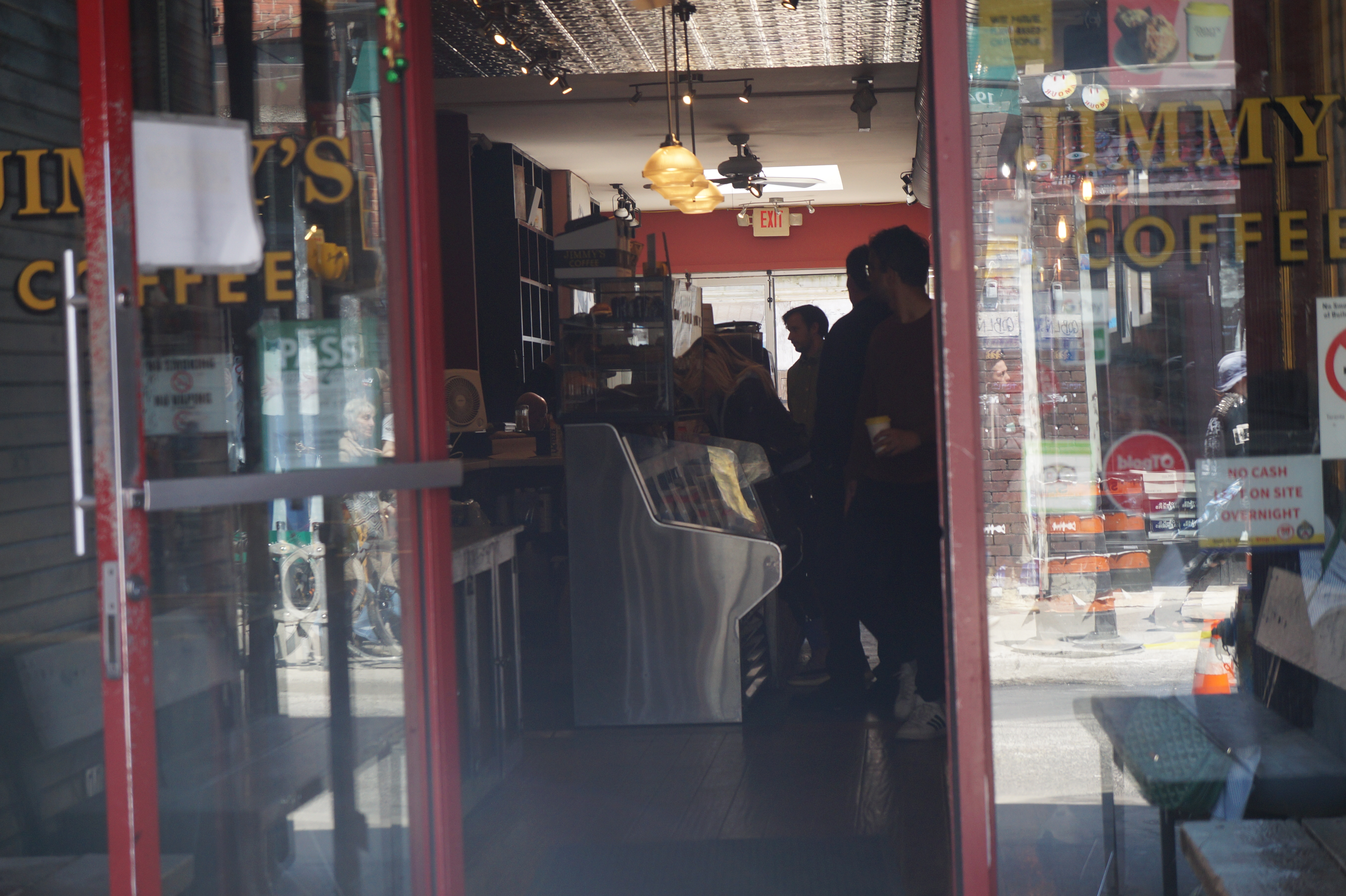
A Pause in the Buzz: Bob at Jimmy’s Coffee, Baldwin Street


In the heart of Kensington Market, where murals watch over taco joints and vintage stores spill out onto sidewalks, Bob took a well-earned break from wandering the neighborhood’s maze of sights and sounds. His destination? Jimmy’s Coffee on Baldwin—a cozy refuge tucked behind a red-framed doorway, nearly
hidden by reflections and the constant hustle of the street.

The first impression is a flash of layered moments: sunlight bouncing off glass, silhouettes queuing patiently, and the warm hum of espresso machines behind the door. Bob stepped into the dim, narrow cafe and was greeted by the familiar scent of roasted beans and the comforting clatter of ceramic cups. There’s a timeless charm to Jimmy’s—low-hung lights, pressed-tin ceilings, and the quiet camaraderie of caffeine-seekers.

He grabbed a cup, slipped past the crowd, and headed toward the back—where Jimmy’s reveals its secret: a sunlit lounge and patio. The back room, with its hodgepodge of vintage chairs, murals, and big glass doors, offers a slower pace. Here, light filters gently across chipped tables and the buzz of the espresso bar fades into soft conversation, headphones, and books cracked open under streaks of sunlight.

One person typed away behind a laptop covered in comic book decals. Another, red curls tucked under headphones, sipped slowly from a yellow-lidded cup, eyes lost in a book. Outside, in the hidden patio courtyard, a man leaned back in the spring sun, framed by a wall-mounted bicycle and a cheerful mural of a yellow fish-like creature.

For Bob, it was the perfect intersection of observation and rest. The kind of place where a street photographer blends in, unnoticed, while soaking up stories in the small details—faded cushions, mismatched chairs, and half-finished lattes beside worn notebooks.

Jimmy’s on Baldwin isn’t just a coffee stop. It’s part of Kensington’s rhythm—a brief pause where the city's tempo dips just enough to let a person breathe, reflect, and maybe, just maybe, get inspired for the next shot.


Sunday, May 11, 2025

Bird watching Without a Clue – Bob at Colonel Samuel Smith Park


Bird watching Without a Clue – Bob at Colonel Samuel Smith Park

It was a warm spring day when I, Bob the photographer, wandered into Colonel Samuel Smith Park with my camera in hand and not a single clue about birds in my head.

The park, tucked along the lake shore in Etobicoke, was buzzing with new life. The grass was bright, dotted with yellow dandelions, and the air was alive with the sound of chirping. Perfect day for a photo walk. I wasn’t out looking for anything in particular—just scenes, colors, and characters that catch the eye.

And catch the eye they did. First, a familiar figure—a robin—hopped across a patch of grass, chest puffed out like it ran the place. I crouched low, camera ready, as it paused among the dandelions, looking very much like it wanted to pose. Click.

Further along, I stumbled upon a couple of birds perched neatly around a weathered nest box. They shimmered with blue, white, and black feathers—sleek little things. They looked like they knew they had good feathers. I took my time, getting closer, grabbing a few angles before they zipped off and circled back.

Just as I was reviewing the shots, a pair of birders approached me. You could tell instantly—they had big cameras, bigger lenses, binoculars swinging from their necks, and a bird book in hand like it was a holy text.

"Seen anything interesting?" one of them asked, flipping open a page to what looked like the exact blue bird I just shot.

I straightened up and smiled. "I'm Bob the photographer. I just go around Toronto taking photos. I do not know any birds."

They laughed. “Well, looks like you found a robin and a pair of tree swallows,” one of them said, peeking at my LCD screen. “Good eye!”

Apparently, those shiny blue birds were tree swallows, and the robin? Well, even I knew that one. Kind of.

We chatted for a bit—me, with my photos, and them, with their knowledge. They offered some names, showed me how to ID birds by silhouette and color patches, and even recommended an app to keep track. But I stuck to my truth: I’m here for the photos, not the names.

Still, walking back through the park, I started to notice things differently. The way the swallows soared like tiny jets, the bold way the robin strutted—it was more than just scenery. They were little characters in a city park play. And maybe, just maybe, I’ll learn a few names along the way. Or not. I’m still Bob the photographer.


Friday, May 9, 2025

Bob at Centre Island — A Day using Kentmere 400


It was one of those moody spring days on Centre Island—overcast skies, bare trees still holding off on budding, and the lake water reflecting every branch with eerie precision. Bob, ever the curious street photographer, chose this quiet weekday for a photo walk. This time, he brought along his Sony mirror less camera set to a custom film simulation inspired by Kentmere 400—a black-and-white film known for its classic grain, soft tones, and gentle contrast.

The Willow Grove

At the edge of the pond, Bob stood still, drawn to the way the trees arched and mirrored themselves in the glassy water. The Kentmere simulation brought out the silvery texture of the sky and let the shadows of the branches bleed gently into the water. There was a quiet poetry here—nothing moved, not even the ducks. Bob clicked the shutter, knowing that color would only distract from the stark, dreamy symmetry before him.

Far Enough Farm Nostalgia

Bob’s next stop was Far Enough Farm, where he found a charming old tractor parked beside a wooden cart. “Est. 1959,” the lettering read. It was as though time hadn’t moved since then. The Kentmere simulation gave the image a documentary feel—more observation than nostalgia, with rich mid tones and subtle detail in the shadows. It felt honest, like something that might’ve been printed in a local paper sixty years ago.

The Tandem Ride That Never Was

Parked near a closed building, Bob found a tandem bicycle waiting like an idea that had never quite happened. The bike, clean and perfectly aligned, stood out against the textured pavement and dark garage doors. In monochrome, the playful curves of its frame took on a sculptural quality. The Kentmere recipe rendered the scene with a hint of film grain—just enough to suggest this could be a memory rather than a moment.

The Look of Kentmere

Bob’s Kentmere 400 simulation added more than an aesthetic to his images—it changed how he saw the island. Where color might have softened the mood or romanticized the setting, black-and-white revealed structure, silence, and story. The simulation preserved detail but let contrast remain gentle, capturing that timeless look of a slow day far from the city’s pulse.

As the ferry pulled away from the island, Bob looked back at the shoreline. He had a pocket full of images, but more than that, he had a feeling—like he’d stepped through a threshold into a different Toronto, one that still spoke in whispers, in gray scale, in grain.


Thursday, May 8, 2025

Why I'm Still Using My Sony a5000 and a6000 — And Why You Might Be Too


Why I'm Still Using My Sony a5000 and a6000 — And Why You Might Be Too


Let me start with this: my Sony a5000 and a6000 are still working just fine. They've been through rain, snow, and more than a few sketchy alleyways on photo walks. The lenses are scratched, the grips are shiny from wear, and the menus feel like home. And yet, every camera club meeting I go to, someone asks, "Bob, when are you going to upgrade?"

My answer? Maybe never. Especially now.

The New Camera Hype vs. Real-World Use

Yes, the newest full-frame mirror less monsters are impressive. The auto focus can track a squirrel doing back flips while you're sipping coffee. But for street photography, travel, and daily use, my trusty a5000 and a6000 still deliver. I know them. I know how to push their JPEGs, how to work around the ISO noise, how to squeeze every ounce of drama out of a flat sky.

More importantly — they’re light, discreet, and easy to carry. Try pulling out a $4,000 camera with a white telephoto lens in Kensington Market. You’ll feel more like a surveillance agent than a street shooter.

Tariffs and the Price Wall
Now here's the twist. In case you haven’t been watching the news, camera prices are going way up. With new tariffs on imported electronics — especially anything with advanced image sensors — the latest models are suddenly even more out of reach. That $2,800 upgrade you were eyeing last year? It's now $3,400 before tax.

People in the camera clubs are starting to grumble. They want the new toys, but now they’re facing a reality check: the old gear is going to have to last a lot longer.

Embrace the Old

So here I am, wandering Toronto with my decade-old cameras, experimenting with film simulations, using adapted manual lenses, and printing my photos with a Canon Selphy CP1200. While others are stuck comparing specs online, I'm out shooting.

I say let the gear heads chase specs. If you’ve got a Sony a5000, a6000, or any older mirror less camera — keep using it. Learn it inside out. Push its limits. Post your work. The images still matter more than the megapixels.

And hey, in a few years, we might all be retro cool again.

Stay sharp,
Bob

Wednesday, May 7, 2025

Cherry Blossoms and Stormy Skies: A Velvia Day on Centre Island


Cherry Blossoms and Stormy Skies: A Velvia Day on Centre Island

Spring arrived late this year, but on a grey day in early May, I packed my Sony and set sail for Centre Island, chasing cherry blossoms and reflections under moody clouds. With the trees just beginning to bloom and the sky refusing to brighten, it felt like the perfect test for my Velvia film simulation—a setting designed to pop colours and boost contrast, ideal for overcast days.

The Walkway of Blossoms
As I stepped onto the island, the cherry trees were just catching their stride. Pale pink petals lined the main walkway like a seasonal guard of honour. While the lighting was flat, Velvia’s punchy saturation gave the scene life. The blossoms glowed against the mossy greens and muted browns of early spring—almost as if the photo had been pulled from a postcard rack in the 1990s.

Cherry trees in bloom, under dramatic clouds

The simulation deepened the pinks and sharpened the shadow edges. Velvia doesn’t lie—it amplifies.

Along the Shoreline
Next stop: the beach. The lake was calm, the sand still cool from spring rain, and not a swimmer in sight. The palette here was more muted—beiges, dull greens, and greys—but Velvia still managed to carve definition into every ripple and tree branch. The weeping willows in the distance turned an electric yellow-green that probably wasn’t quite accurate… but it sure looked great.

Empty beach, trees just budding, lake stretching wide

Velvia’s colour boost gave the shoreline a nostalgic, almost dreamy tone—like a memory from a 90s travel brochure.

Skyline Reflections
From the island’s edge, I faced the CN Tower and the dense wall of glass towers that define Toronto’s skyline. Water in the foreground, city in the back—this is a view I’ve shot a dozen times, but today felt different. The dark sky added drama, and Velvia made the water shimmer with teal and steel-blue tones. Even without sunlight, the simulation gave the photo punch.

The Toronto skyline framed by island foliage

With Velvia, the glass towers cut sharply through the haze, and the forest on either side looked richer and deeper.

Notes on Shooting

Using the Velvia film simulation was a conscious choice for this trip—its exaggerated saturation and high contrast are risky in bright sunlight, but perfect for cloudy spring days. I shot in JPEG with in-camera settings for minimal post-processing, relying on:

Creative Style: Vivid

Saturation: +2

Contrast: +1

Sharpness: 0

DRO: Level 3

White Balance: Daylight with slight magenta shift

It’s not a true Velvia slide, but it gave me that nostalgic FujiFilm look—like seeing the world through a photographer’s rose-tinted glasses.

If you're a fan of vibrant colours and don't mind bending reality a bit, try a Velvia-style setup next time the skies are grey. Sometimes, the best colour shows up when the sun doesn't.


Sunday, May 4, 2025

Bob’s Spring Visit to Centreville: A Nostalgic Stroll on Centre Island


On a crisp spring morning, Bob boarded the ferry to Centre Island, armed with his camera and a cup of strong coffee. His destination? Centreville Amusement Park—a charming, old-school gem nestled among the trees and waterways of Toronto’s island chain. Though the rides weren’t open yet, the park was waking up after a long winter, and Bob was there to capture the stillness before the summer crowds.

First, he wandered over to the log flume ride. The boat, labeled “Centreville,” sat frozen in place, half-submerged in water cascading dramatically over the edge. The sound of rushing water filled the air as Bob snapped a few shots, admiring how the ride looked both abandoned and alive at the same time.

Next, Bob followed the path to the miniature train. The vibrant blue locomotive, proudly flying two Canadian flags, was parked on the tracks with its staff preparing it for the season ahead. “The Centreville Express,” it read. Bob chuckled—it reminded him of old postcards and childhood visits. He gave the crew a nod and took a photo that framed the train against a backdrop of early spring trees.

His last stop was the carousel. Even without the music and motion, the painted horses looked like they were frozen mid-dance, ready to spring to life. Each animal had its own character—snarling lions, wide-eyed pigs, and elegant horses with decorative saddles. Bob lingered here the longest, fascinated by the artistry and the nostalgia it evoked.

As he made his way back toward the ferry, Bob felt like he had stepped through a time warp. Centreville wasn’t just a children’s park—it was a memory machine, quietly spinning its gears until summer returned. 


Friday, May 2, 2025

Bob Spots a Drone Survey Team at Centennial Park


You never know what you’ll stumble across during a casual walk in the park — especially if the park happens to be under a flight path. Centennial Park, nestled just west of Toronto Pearson Airport, is normally known for picnics, baseball, and the occasional soccer tournament. But on this chilly spring morning, Bob spotted something that looked more like a science fiction scene than a stroll in the park: a drone survey team at work.

At first glance, it looked like a giant robotic spider resting on the grass — four arms, black carbon fiber, serious equipment. No propellers spinning yet, but you could tell this wasn’t some backyard drone enthusiast. These folks meant business.

Bob, ever the curious citizen photographer, wandered a bit closer and struck up a conversation.

Turns out the team was conducting a topographic survey of the park. They were mapping the terrain using a high-resolution drone equipped with LiDAR (that's Light Detection and Ranging, Bob learned — kind of like radar, but with lasers). The data would be used for planning and development purposes, possibly tied to drainage systems, trail work, or future park improvements. Given the size and accuracy of the setup, this wasn’t just hobbyist gear — it was serious commercial surveying equipment.

Bob asked if it was okay to take a few photos, and the team gave a thumbs-up — as long as he didn’t cross into their safety zone. Fair enough.

While they continued prepping the drone, another team member was setting up a tall tripod-mounted GPS receiver nearby, part of their ground control system. The whole operation was precise and professional. Bob was impressed by how seamless and quiet the process was — high-tech, but low drama.

What fascinated Bob the most was how casually this futuristic scene blended into an ordinary park. There were geese off in the distance, a few joggers running past, and here in the middle — a team quietly scanning the Earth from the sky.

So next time you're in the park and hear a buzz overhead, it might not just be a bee. It could be the future of surveying at work — and Bob might already be talking to them. 

Thursday, May 1, 2025

A Spring Stroll: Bob's Cherry Blossom Hunt at Centennial Park


There’s something magical about cherry blossoms—those delicate pink and white petals fluttering in the breeze have a way of making even the cloudiest day feel like a celebration. This week, Bob packed up his camera and made his way to Centennial Park in Toronto, eager to catch the fleeting beauty of spring in bloom.

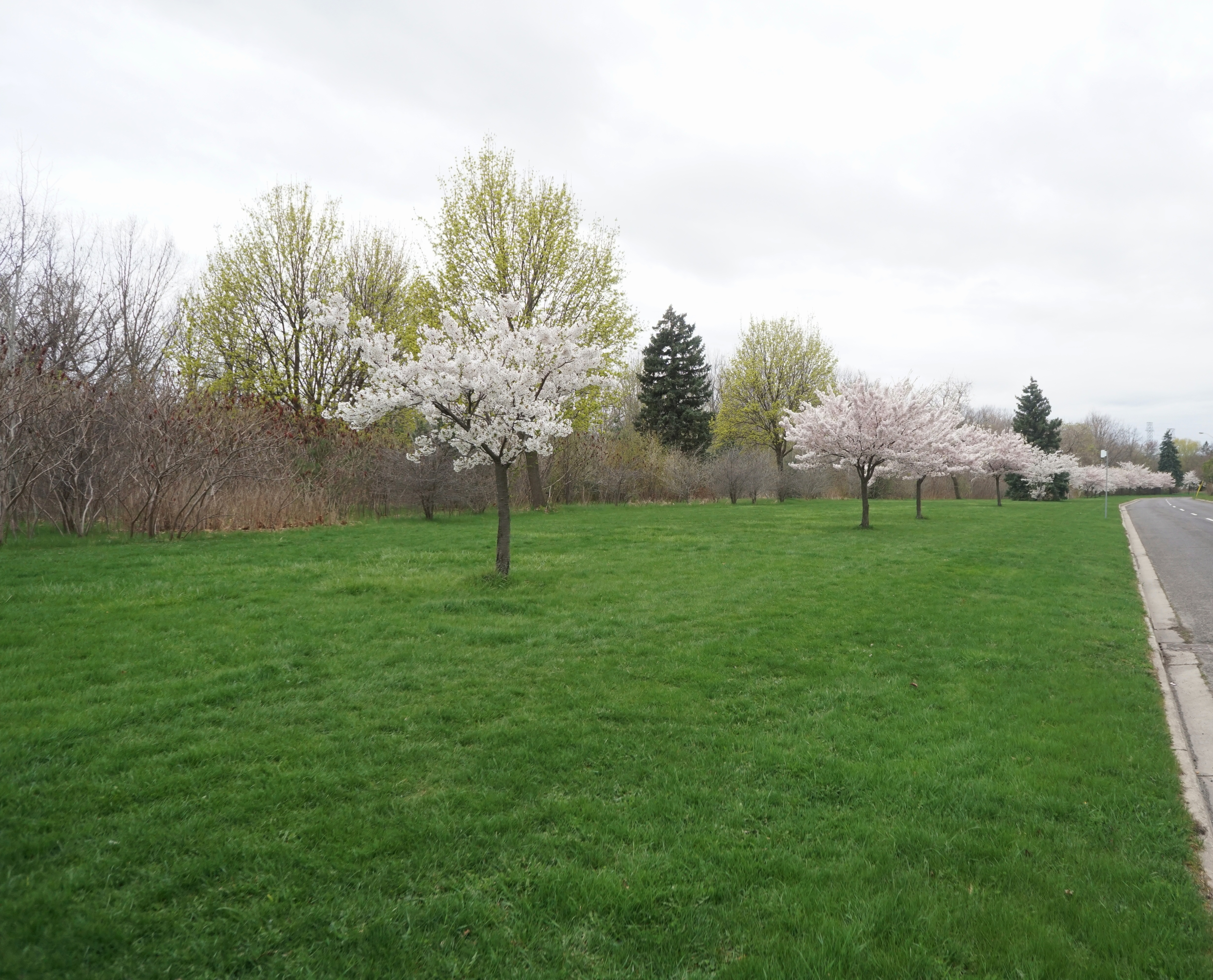
As soon as he arrived, he was greeted by rows of cherry trees lining the edge of the park. Despite the overcast sky, the blossoms stood out like brushstrokes of light, dancing over a canvas of green grass. Bob started with some wide shots to show the peaceful layout of the park: soft green fields stretching out beside a quiet road, dotted with the pale blooms that only show themselves for a short time each year.

Of course, Bob couldn’t resist going in for a close-up. With his macro setting on, he focused in on the heart of a single blossom. The result? A dreamy image where the yellow stamens popped against the creamy white petals, revealing the quiet elegance often overlooked when seen from afar.

As he wandered deeper into the park, Bob paused to capture a signpost under a canopy of tall pine trees. "Centennial Park," it read, a modest marker for a spot that turns into a springtime wonderland for just a few weeks a year. The cherry blossoms here may not be as famous as those in High Park, but to Bob, they were perfect—no crowds, just quiet beauty and a gentle breeze.

This trip was a reminder of why Bob keeps his camera charged and ready. Nature doesn’t wait. When spring calls, you answer—with a shutter click.

Have you found your own blossom moment this year? Let Bob know in the comments or share your favourite spring spots in Toronto.

Improve Your Photography by Practising Localism

One of the best things I have learned from years of photography is that you don't have to travel halfway around the world to find someth...